Chapter 7. GUI
In this chapter, we will implement the whole GUI from the beginning to the end. This chapter may require you to have basic background of Qt GUI and Model-View framework.
This chapter will be the part where the source code grows enormously, but most of them share common patterns in their implementation. Instead of covering all of source code, I will explain patterns used in this part and overall UML diagram.
Not like other chapters which takes one commit per a chapter, source code for this chapter is too long, they are separated into multiple commits. This is the last chapter, and you can get the full commit for this chapter by taking the latest commit.
Data Tree Mimic
Data Tree Mimic is a proxy pattern-like pattern which provides object tree mimicking target data tree.
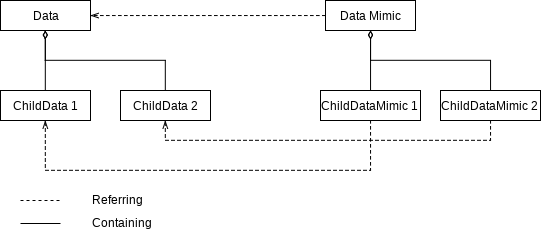
The above diagram shows relationship between source objects and mimicry objects. There’s a root mimicry object, which refers source data, and the mimicry’s children refers the source data’s children as well.
To make a mimicry of a data class, it should be able to send events of its children add/remove, and its data.
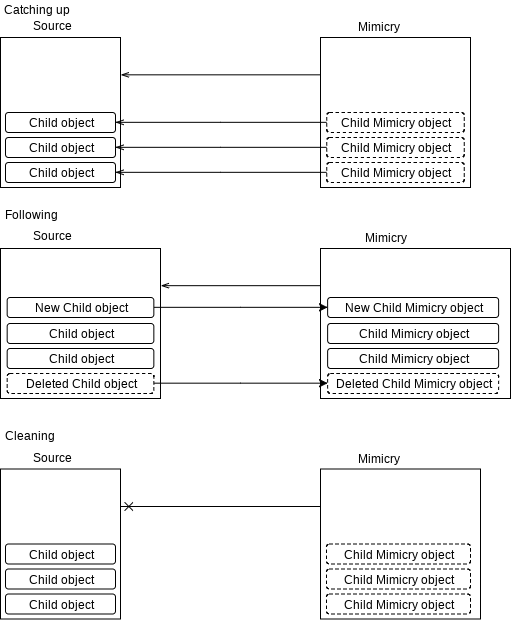
When just a mimicry object is constructed, it will not be connected with its source data. And somewhile, the source data will be set, and the mimicry object tries to catch up the source.
After it finished catching up, it starts to follow the source. Whenever any of value in source data is updated, the mimicry object takes and handles them. If they are related to children add/remove, it creates or deletes its child mimicry type.
If the mimicry object doesn’t need to follow the source longer, mimicry deletes all of its children and disconnects every signals.
Subclassing Context Holder
For some classes, Context instance is not enough to represent their
“context”. For example,
TreeItemView object is also part of context of tree_item_view_sub::View
class.
In the overall code for GUI, subclassing ContextHolder and adding
their new context is used. If using public inheritance just for convenience
is not your flavor, you can just add init() and context-getter methods
manually, as described when I introduced Context first.
Dependency Management between Data and Data Tree Mimic
Referring Data subclass instance commonly happens when using
mimicry pattern. In Data class, addDepended(), removeDepended(),
and purgeDepended() are used to manage dependency and mimicry object
is not the exception.
Mimicry object is not Data subclass, but just C++ instance, it should
use DependencyKey to identify itself. Storing its pointer(this) will
work in most cases without problem.
Not all of mimicry objects need to call addDepended(), actually it must
not. Only root mimicry object of tree should call addDepended() when they
refer a Data instance, and purgeDepended() must be invoked when
they stop referring.
What is the difference between removeDepended() and purgeDepended()?
removeDepended() expect that depended object uses same command manager,
and understand that the depended object exists whenever run() or
undo() of Data::solution() is called. While,
once purgeDepended() is called, the depended object will never invoked
in any way from Data::solution() result.
If depended object uses the same command manager or
ensured that it will live forever, use removeDepended(). If it’s not,
use purgeDepended().