Chapter 3. Form Data Tree
In this chapter, we will implement the data tree introduced in Chapter 1. Since forming data tree is really simple, I’ll show only some examples. The whole implementation can be found in the source code.
You need to open the source code committed with message
003. Form Data Tree before read the extra chapter.
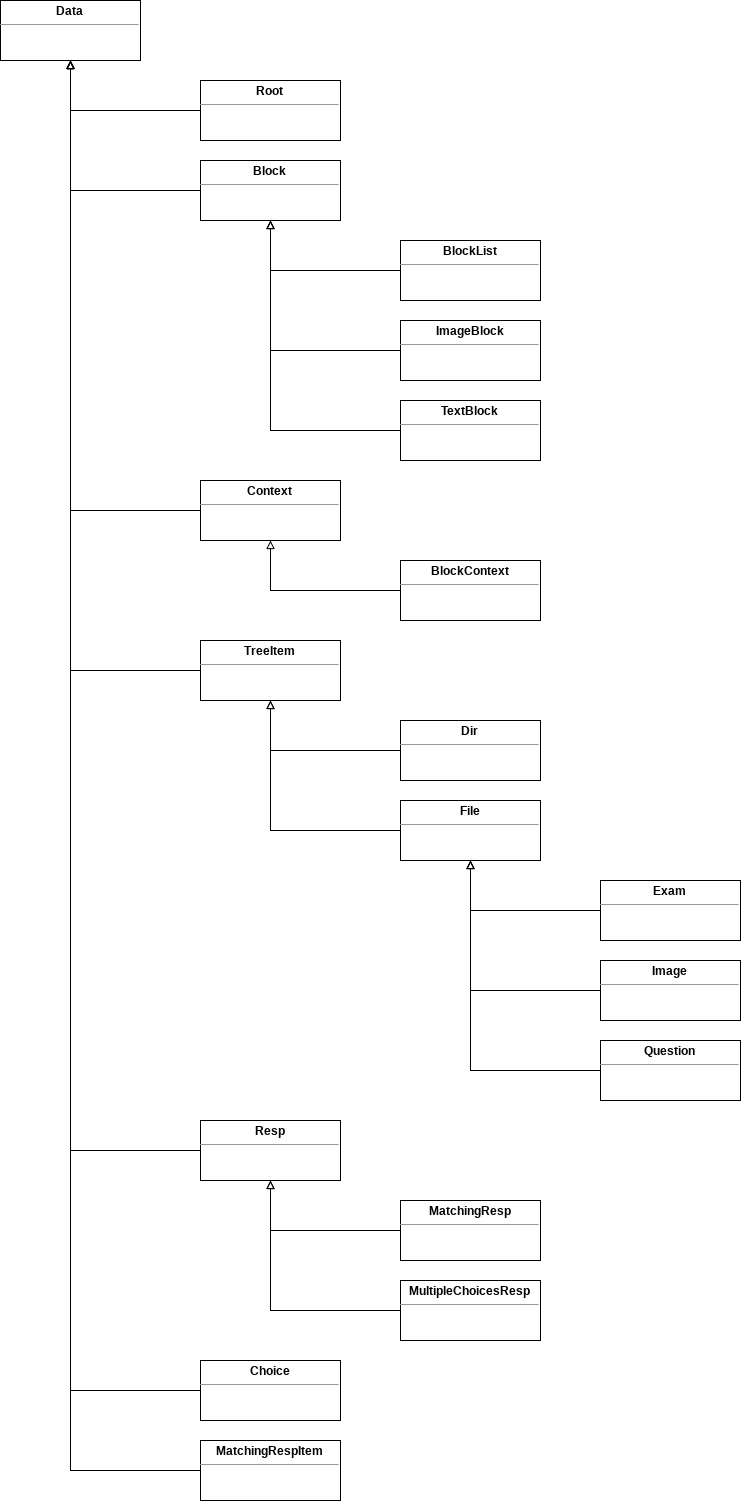
This is a simple hierarchy diagram to help understand the overall hierarchy tree. To see the containing relationship, it’s in Planning.
Implementing Root: Using SingleContainer
Open root.h.
As you can see in the source code, there’s literally nothing special and complex, since we prepared the complex base classes properly.
Below one is the follow-up guide when you add a child data container.
- Name it: in this case, it’s “root dir”.
- Do type aliasing: in this case
RootDirContaineris aliased toSingleContainer<Dir, std::shared_ptr<Dir>>. - Declare the aliased container as member variable.
- Provide 2 versions of getter for the container member variable, const and non-const version.
- Make sure that
Data::containers()are well-overridden so that it returns all of its children container. Do not return container for refernece, which is not container for ownership.
Beside the guide above, make sure that your new Data subclass is
registered to DataType enum class in data_type.h file, and its
type() virtual method returns right DataType.
Implementing Choice: Using SinglePrimContainer
Open choice.h.
SinglePrimContainer is used to take a value type. The same way applied
to add this container, but since this is not a container for Data,
Data::containers() should not include this container.
Implementing ImageBlock: Referring Other Instances
Open image_block.h.
This class has ImageContainer type alias, which is
SingleContainer<Image, TypeEnum::Ref>. To refer Data instances
instead of taking ownership, pass TypeEnum::Ref instead of passing
smart pointer type. Data::containers() should not include this container.