Chapter 1. Basic Data Module
In this and next chapter, how to prepare base code to form data tree will be introduced. Regardless of which data type will be dealt with in your editor, the base code, at least it’s principle will not change.
You need to open the source code committed with message
001. Basic Data module before read the extra chapter.
Superclass of All Data Classes
Though every data representing classes have different data, they are data
objects which consist data tree, and it’s always good to have one common
superclass. I’ll name the superclass Data. There are some basic
requirements applied to Data, listed below.
- Know what its parent is.
- Know what its children are.
- Know what its type is.
Class Data is declared and defined in data.h and data.cpp. In
the definition, there are methods type(), children() and parent()
to fulfill the requirements above. type() is pure virtual function, and
its subclass should return corresponding enum in its implementation.
You may wondering what parentContainer() and containers() are, and
why children() and parent() methods are not pure virtual
even though Data does not
know about its children since they will be defined in the subclass.
Interfacing Data as Data Container
Background
Assume there are subclass of Data, A, B, and X. A and B are list
container of X.

A and B have same interface, so it will be good idea to make common interface
something like XContainer. There are several ways to make interface, and
the most popular way in OOP is creating
pure abstract class(called as interface, in Java).
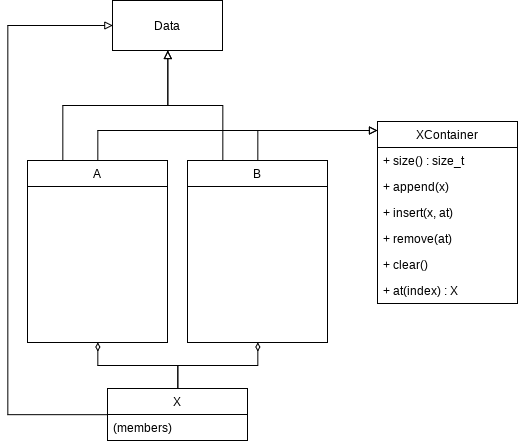
Now A and B can be dealt as XContainer. However the problem is not gone
yet, because a Data subclass is not a container for only one type
of Data. For example, our MatchingResp type takes 2 lists of
MatchingRespItem, and there’s no way to inherit something like
MatchingRespItemContainer twice. To solve this situation,
A data is container of container of children data pattern is introduced.
Solution
The problem comes from violation of the OOP rule: One class plays one role.
There are 2 relationships between 2 different objects, one is has-a and
the another is is-a. You may have heard about these 2
relationships in your first
C++ programming cookbook, with addition information that
public inheritance should be used when two classes have is-a relationship.
In this case, it seems that A(or B) and XContainer are
is-a relationship for each
other, but actually it is has-a relationship for A(or B) and X. That’s the
reason why this problem cannot be solved by inheritance. Then what we need to
use to make has-a relationship? Take children container as member.

The image above shows how our Data subclasses have their children.
Instead of having its children directly, Data subclass take
abstract class Container which has children. In this way, Data subclass
can have multiple Containers without any problem.
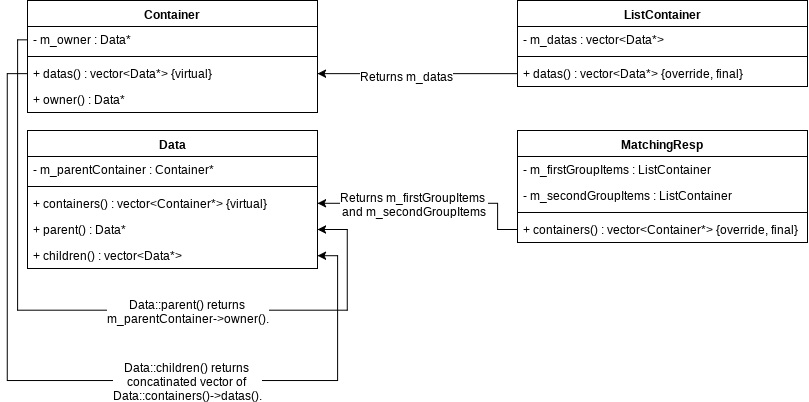
It explains parentContainer(), containers(), children(), and
parent() methods. parentContainer() is the only virtual function
related to parent-child relationship of Data. children() returns
all the Data instances comes from containers(). parent() returns
owner of parentContainer().
Dependency of Object
addDepended(), removeDepended(), and solution() are functions
for object dependency management.
Before we explore what 3 methods above are, understanding of dependency
problem should be preceded.
Background
Object referring has always been one of the most crucial issue in programming. By using referring instead of copying object, programmers could have got performance improvement and kept an object’s uniqueness. But like there’s shadow on the other side of the light, it comes with object lifetime issue. Programming without care of lifetime will cause dangling pointer issue in C/C++.
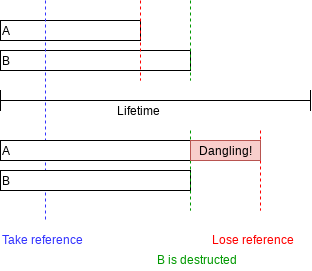
Assume that there are 2 objects, A and B. A take reference of B. If A dereference before B is destructed, everybody can have smiley face. The frowning starts, when A takes longer referring time than B’s lifetime.
The image above exactly shows the previous case. In the upper case, lossing reference happens prior to B is destructed, while the lower case does not. If actual referring(not just taking reference, but try to do something with the reference) happens, that’s the point where we get segmentation fault, and that’s the reason why programmers have stack of empty coffee cups beside them till the midnight.
Solution
This is not technical problem, but it’s logical one. Just like dead solders cannot hear cry of their family, like we cannot eat an apple which does not exist, we cannot access to object which is already deleted.
There are 2 solutions: one is let A dereferences when B is deleted, and
the another is let B alive until A dereferences. To achieve
dereference-when-deleted, B should let A knows if B is deleted. For
deleting-waits-until-dereferenced, A should take ownership of B with
something like std::shared_ptr. The first one is much more complex than
the second one which simply use one more smart pointer, because B should
refer A as well to let A knows B’s deletion.
The first solution will be applied to our Data dependency management,
because different Data subclass instances should not affect to each
other’s lifetime unless they have parent-child relationship.
Going back to our code review, addDepended(), removeDepended(),
purgeDepended(), and solution() are used to manage dependency.
addDepended() takes depended target identifier(DTI) and solution.
DTI is used to identify depended objects. Depended objects can be classified
into 2 types in our case, Data subclass instances and non-Data subclass
instances. Data subclass instances uses its child container’s pointer as
identifier, and other C++ instances can use DependencyKey type to
identify itself from other instances. DependencyKey is a value type
which has nothing but occupies specific size of memory. It looks like this,
#define DEPENDENCY_KEY_SIZE (sizeof(nullptr) * 2)
class DependencyKey { char m_data[DEPENDENCY_KEY_SIZE]; }
Other C++ instances are unknown for Data’s point of view, so it just
let them freedom to fill this chunk of data, but give them responsibility
to make not-crashing key.
The solution is a command object which knows how to solve the dependency.
When it’s run, dereferencing occurs. Undoing the command will reference occurs
again. That solutions are stored in a map container, so that running
all the solutions let the Data instance is safe to be deleted.
A container which contains every solution of a Data instance,
including its children’s solutions, can be got by calling
Data::solution().
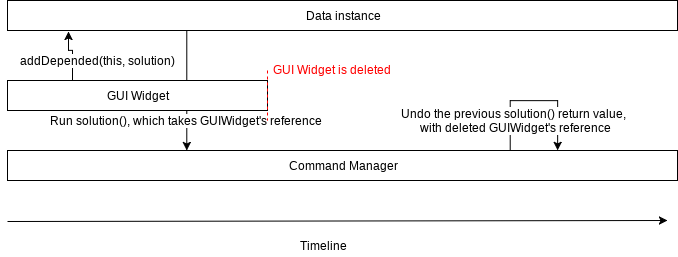
purgeDepended() is introduced to cope with a case when a depended
object is deleted after return value of solution() is still alive.
The image above is little bit complex, and I paraphrased into ordered list
below.
Datais referred byGUIWidget.Data::solution()is called, and it’s run.GUIWidgetis deleted. (Still,Data::solution()’s return value is alive.)- By undoing
Data::solution()’s previous return value, you will get segmentation fault error.
To understand this situation well, you may need experience of writing solution command object. I will have chance to explain this in the later part of the tutorial, and until we reach there, we will never use this function.